Redesigning the Lineup: Gender, Power, and Electronic Music
By DJ SAMURAI - Flavia Furtado
Moving Beyond Symbolic Inclusion in 2026
In 2026, after years of conversations about equality in electronic music, many of us are noticing something uncomfortable: lineups are quietly sliding backwards.
Scroll through major festival posters and you’ll see it. Long lists of male DJs. One woman somewhere in the middle. Maybe one queer act. A single name used to signal diversity.
Let’s be honest, symbolic inclusion isn’t the same as real parity.
Seeing one woman on a lineup doesn’t mean the industry has changed. It just means someone filled the “diversity slot.” While a male-dominated music industry continues to protect its privileges instead of making real room for the abundance of women and queer talent in the scene.
The Numbers Behind the Conversation
According to research from the electronic music network female:pressure, female representation in festival lineups has grown significantly over the last decade. In 2012, women represented just 9.2% of artists performing at electronic music festivals worldwide. By 2022–2023, that number had risen to almost 30%. That’s real progress.
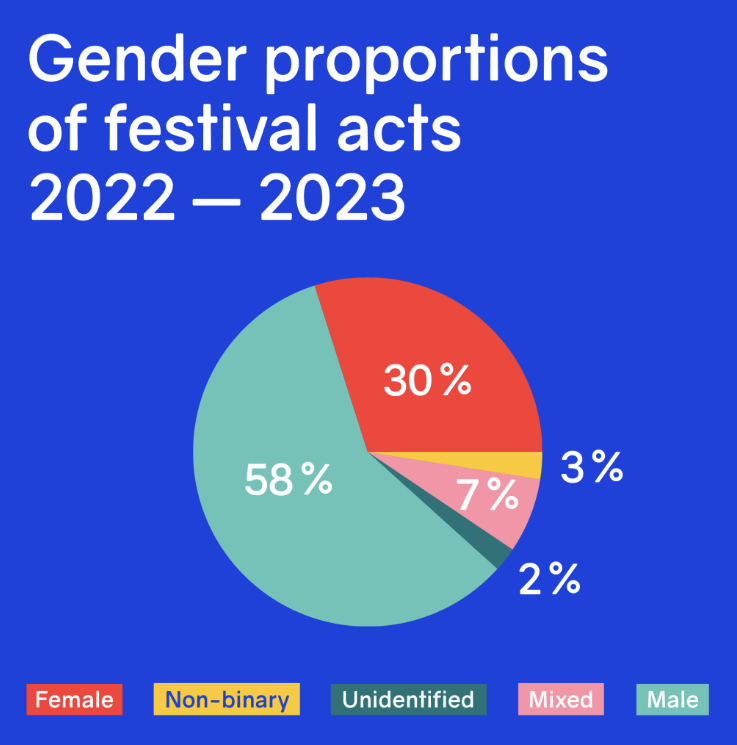
Info graphic by Elisa Metz - female:pressure
But progress is not the same as parity. Even today, men still occupy the majority of bookings across global festivals.
When we zoom in on key scenes, the imbalance becomes even clearer. During the 2025 Ibiza season (one of the most influential club circuits in the world) only around 22% of DJs booked were women or non-binary artists.
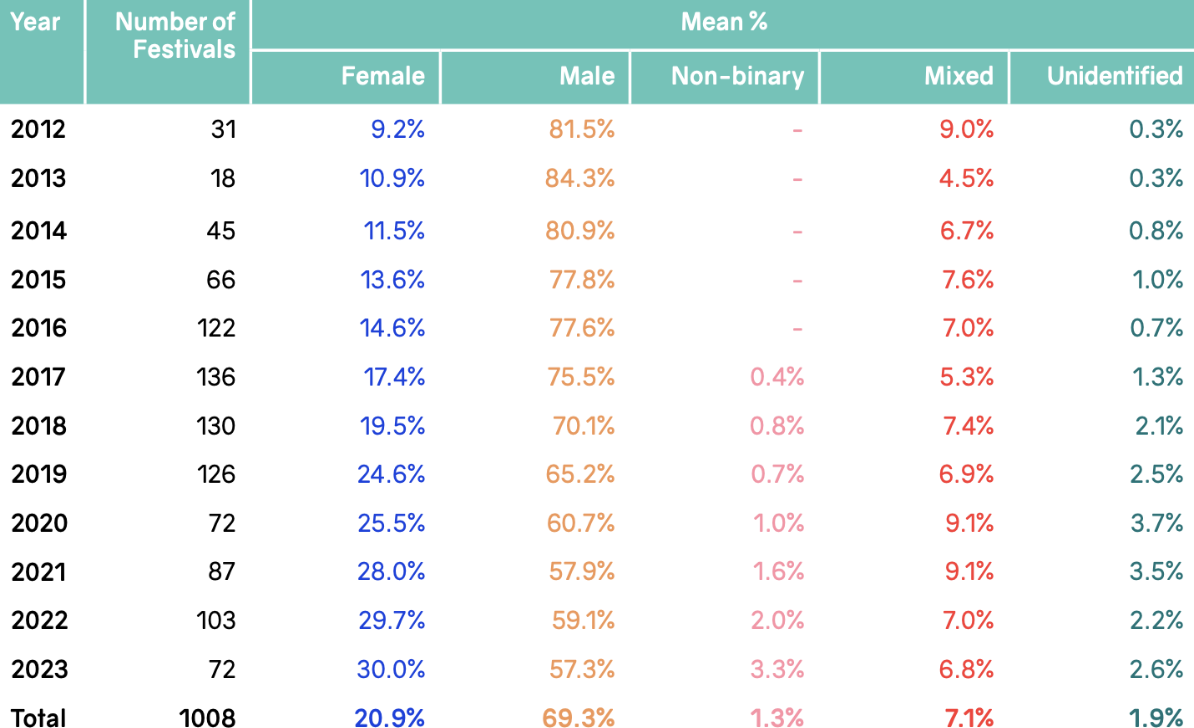
Female, male, non-binary, mixed, and unidentified acts in % over time by female:pressure
Progress? Yes. Parity? Not yet.
And when we look more closely at headliner slots, closing sets, and long-term residencies, the gap often widens even further.
This imbalance also reflects a broader pattern in cultural history. For centuries, the history of art (from painting to classical music to cinema) has largely been written through male perspectives and institutions. But we are now in 2026, in a moment when conversations about equity, diversity, and representation are everywhere.
If there is any field where we should expect openness, experimentation, and new voices, it should be music and the arts. And yet, the industry is still catching up to that promise.
Why Does This Keep Happening?
It’s not about talent. There is no shortage of skilled women and LGBTQ+ DJs. The issue is structural:
Booking agencies remain male-dominated.
Promoters rely on existing networks (which skew male).
Risk-taking often means repeating familiar names.
“We already booked a woman” becomes a conversation stopper.
The result? Inclusion that looks good on a poster but doesn’t shift power.
The “One Woman” Pattern
Many of us recognize it immediately:
One woman in a 15-artist lineup
Women consistently placed in early time slots
Queer artists positioned on secondary stages
Very few women in technical or curatorial roles
When this pattern repeats across festivals, it no longer reads as coincidence but as a cultural norm within the industry. And cultural norms are not permanent; they're the result of habits, networks, and power dynamics that can be questioned, shifted, and ultimately reimagined.
Why Organizations Like Support Women DJs Matter
This is exactly why the work of initiatives like Support Women DJs is not just important, it’s urgent.
I first connected with Support Women DJs when I was invited to New York as an artist with my film “Tesoros”. During that time, I also played several DJ sets across the city (five parties in total) and it was there, at SILO, that I met the community behind Support Women DJs. Seeing their work up close made a strong impression on me.
As someone who has been DJing for many years, I know how challenging it can be for women to gain visibility and recognition in a field that still tends to center male artists. What Support Women DJs is doing is powerful. By organizing events exclusively featuring women DJs, creating real performance opportunities, and building a supportive network. They’re actively correcting a long-standing imbalance.
All-women lineups are not exclusionary. They’re restorative. They create space where there has historically been scarcity, and they help generate confidence, networks, and visibility that ripple outward into the wider music community.
At a time when the industry has also been forced to confront difficult realities (including several high-profile cases of male DJs accused of sexual abuse or misconduct) the importance of building stronger communities among women artists becomes even clearer. Creating safer spaces, supporting one another, and amplifying women’s work is not only about representation; it is about accountability, solidarity, and cultural change.
Grassroots platforms like Support Women DJs do more than showcase talent, they build ecosystems. They mentor, connect, and amplify. They demonstrate that parity is not difficult.
So How Do We Navigate This?
Navigating an industry that still leans so heavily toward male-dominated lineups can feel frustrating. What we need is strategy, awareness, and above all, collective thinking.
One simple but powerful place to start is by asking better questions. Before accepting a booking, it is reasonable to ask organizers whether gender balance is something their festival is actively working toward, or how diverse the overall lineup actually is. These kinds of questions are professional and increasingly necessary. They don’t attack anyone, but they do signal awareness. And sometimes, simply asking the question can shift the conversation in ways that silence never will.
Another way to move the culture forward is by recommending other artists. When we are invited to perform and notice an imbalance in the lineup, we can suggest women or LGBTQ+ DJs whose work we respect. Curators and promoters often rely on trusted recommendations when building their lineups, and that influence can be used intentionally. Visibility expands faster when we amplify one another rather than moving through the industry alone.
At the same time, representation is not only about being present, it’s also about where and how artists are placed within a lineup. Too often women and queer artists are booked for early time slots, while prime-time stages and closing sets remain dominated by men. True parity means access to headliner moments, closing sets, equal billing, and equal pay. Being included but consistently sidelined is not equality; it is simply another version of the same imbalance.
Supporting and building parallel ecosystems is also essential. Collectives, independent promoters, and community-driven events have historically pushed electronic culture forward when mainstream institutions moved too slowly. Attending their events, collaborating with them, sharing their work, and strengthening those networks helps create alternative spaces where diversity is not an afterthought but a foundation. When we support these ecosystems, we strengthen the entire scene.
Finally, one of the most important shifts we can make is refusing the idea that there is space for only one of us. The industry sometimes creates a subtle sense of scarcity, as if each lineup has room for a single woman. But this scarcity is artificial. There is no shortage of talented women and LGBTQ+ DJs. What often exists instead is a shortage of imagination. When we stop competing for that single acceptable spot and begin supporting each other publicly and visibly, the structure itself begins to change.
Audiences today are more aware than ever, and younger generations no longer see diversity as a bonus feature but as a basic expectation. Organizations like Support Women DJs are already showing what that can look like in practice. Creating platforms where women artists are visible, connected, and taken seriously. If electronic music truly wants to remain a forward-thinking culture, its stages must reflect the multiplicity of voices that shape it. The future of the scene is not singular; it is expansive, and there is more than enough room on the lineup for many of us.